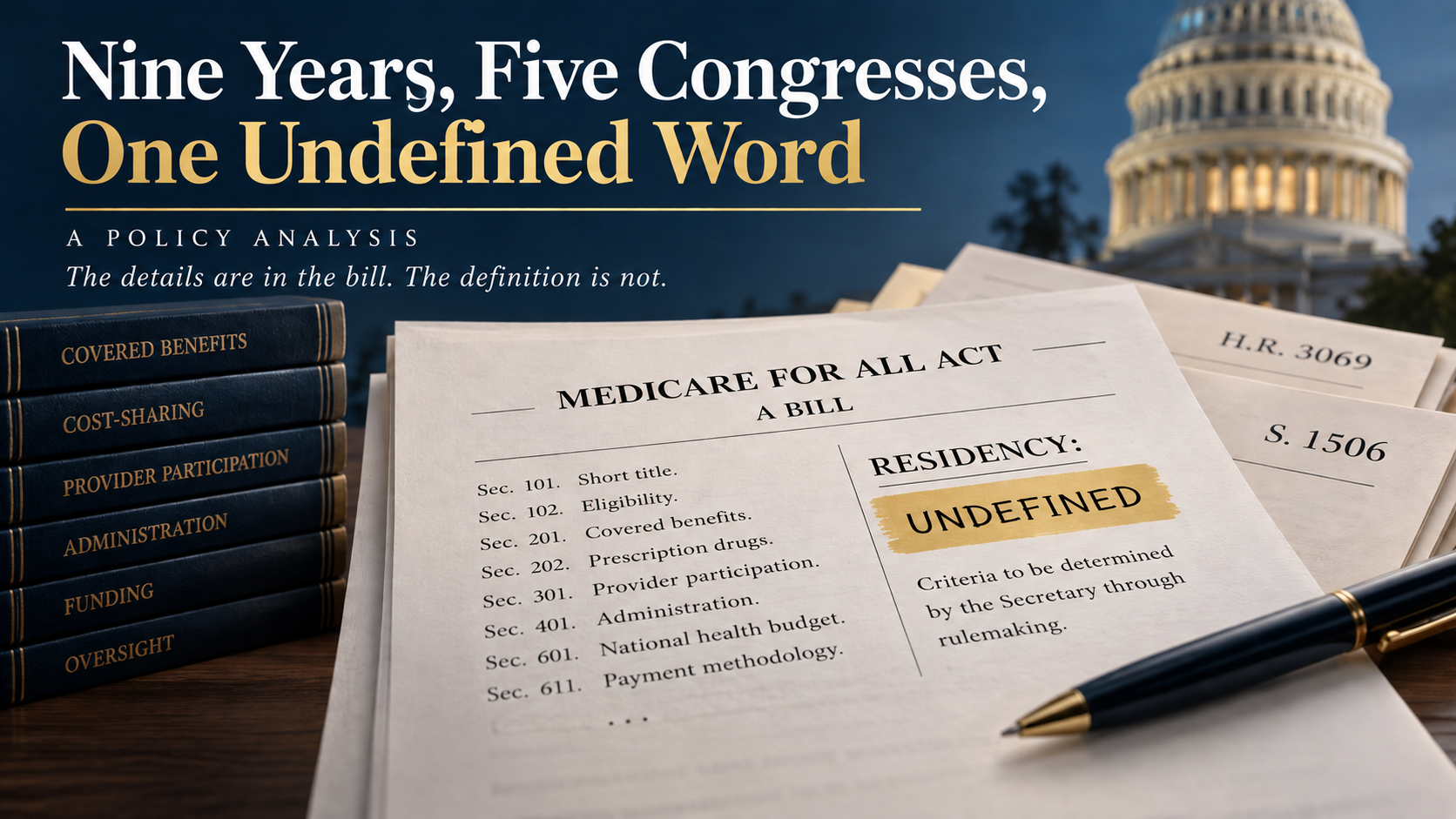
Medicare for All has been introduced in five straight Congresses since 2017. Not one version defines who counts as a resident. That word decides who gets covered, and every bill leaves it to the Secretary, in a rule that still hasn’t been written.
The Medicare for All Act was introduced in both chambers on April 29, 2025. H.R. 3069 in the House, from Rep. Pramila Jayapal with Rep. Debbie Dingell. S. 1506 in the Senate, from Sen. Bernie Sanders. Both would establish a national health insurance program covering every resident of the United States. Both are sitting in committee, and neither has had a floor vote. None of this is law, and no version of it ever has been.
Here is the operative eligibility language. This is Section 102(a) of the Senate bill.
“Every individual who is a resident of the United States is entitled to benefits for health care items and services under this Act. The Secretary shall promulgate a rule that provides criteria for determining residency for eligibility purposes under this Act.”
The House text differs by two words. It says benefits for health care services where the Senate says health care items and services. The second sentence is identical.
Section 102 doesn’t end there. Subsection (b) lets the Secretary make eligible “other individuals not described in subsection (a)” and regulate their eligibility “to ensure that every person in the United States has access to health care.” Both bills carry that authority.
So the section delegates twice. Congress picked the eligibility category, residents of the United States, and handed the Secretary of Health and Human Services both the criteria for deciding who’s in it and the authority to cover people who aren’t.
Those two aren’t the same kind of instruction. The Secretary may extend eligibility; the Secretary shall write the residency criteria. And Section 105(a)(1) hangs automatic enrollment on establishment of residency rather than on the extension authority, which makes the residency rule the one the enrollment system runs on.
The Secretary is going to write that rule either way. The open question is what boundaries Congress sets around it before enrollment begins.
Eligibility is the program. If you can’t say who qualifies, you can’t say what it covers or what it costs.
I spent years reviewing federal loan files for eligibility and compliance, much of it after money had already been disbursed. That experience taught me a simple operational lesson. A term left for later definition doesn’t eliminate the determination. Someone still has to make it, using whatever rule, evidence standard, and review process ultimately exists.
These aren’t vague bills
You could read Section 102 as ordinary legislative shorthand. The rest of the bills don’t read that way.
Section 201 lists covered benefits by category, seventeen of them in the Senate bill and eighteen in the House. It gets down to the level of naming licensed marriage and family therapists and citing sections 441.530 and 441.710 of title 42 of the Code of Federal Regulations by number. The chambers even differ on how those citations operate: the Senate freezes them as in effect on the date of enactment, while the House allows a successor regulation.
Section 202 in the Senate bill caps prescription drug cost-sharing at $200 annually per individual, adjusted for inflation, and exempts households at or below 250 percent of the poverty line. The House takes a different route, barring cost-sharing and expressly addressing prior authorization and step therapy.
Section 301 specifies what a provider participation agreement must contain, including a 30-day billing deadline and a prohibition on board members holding financial interests in entities that contract with the provider. Section 601 divides the national health budget into eight named components. Section 611 lists nine factors to be considered in negotiating a hospital’s global budget, and four limits on what those payments can include or be spent on.
Both chambers even write the transition schedule down to ages and dates, and they write it differently.
These are carefully drafted documents. Against that level of specificity, Section 102 stands out. Congress selects residency as the eligibility criterion but leaves the criteria for determining residency to the Secretary. Age is straightforward to administer because it’s a defined, record-based fact. Residency is the harder one, and that’s the one left open.
Section 401(a)(1) starts the Secretary’s general duties with “eligibility for benefits” and “enrollment,” so both bills assume something will administer eligibility. Neither supplies the test it would apply.
Four things the text leaves open
The non-discrimination provision has a hole shaped like the missing rule.
Section 104(a) bars exclusion from the program on a long list of grounds, including citizenship status. Then it carves out an exception: actions “expressly authorized by this Act for purposes of enforcing eligibility standards described in section 102.”
Those standards are the ones the Secretary hasn’t written. So the bill grants a protection against exclusion and makes the size of that protection depend on a rule that doesn’t exist yet. Whatever the residency criteria turn out to be, they set the width of the exception.
A purpose test with no evidence standard.
Both bills address medical tourism, and both do it in Section 102(b). The Senate directs the Secretary to promulgate a rule, consistent with federal immigration laws, preventing an individual from traveling to the United States for the “sole purpose” of obtaining covered health care. The House instead tells the Secretary, in regulating eligibility under that subsection, to ensure individuals aren’t allowed to travel here for that purpose.
The two texts place that obligation differently, but both leave the same implementation question. “Sole purpose” is a finding about intent. Neither bill specifies what evidence establishes that intent, who makes the determination, what evidence the individual may submit, or how an erroneous determination is corrected.
Delegation answers who writes the rule. It doesn’t answer how the rule works in an individual case.
Enrollment begins with an event the bill doesn’t define.
Section 105(a)(1) requires an enrollment mechanism that includes automatic enrollment at birth in the United States “(or upon establishment of residency in the United States).”
Birth is an event with an established record. Establishment of residency depends on the criteria that Section 102 directs the Secretary to create. The enrollment mechanism therefore depends on the later residency rule. One statutory sentence generates a chain of operational decisions.
The fraud provisions don’t reach this.
Section 411 incorporates existing federal health-care fraud and abuse authorities, including Social Security Act sections 1128, 1128A, 1128B, 1124, 1126 and 1877. None of them reaches how a residency determination gets made under Section 102, or how a wrong one gets fixed.
The same distinction appears in the appeal provisions. Section 203(b)(2) directs the Secretary to establish a process for appealing coverage decisions, following the Medicare appeals process at section 1869 of the Social Security Act. It sits inside the subsection on experimental items and services. Section 404 authorizes the Beneficiary Ombudsman to help individuals seek appeals of decisions or determinations.
Neither bill, however, expressly creates an appeal process for a Section 102 residency-eligibility determination. So the legislation itself doesn’t specify how a person denied eligibility under the eventual residency standard would contest that determination. That’s the gap I’d want closed in the text.
What the definitions sections do define
Both bills contain definitions sections. The Senate’s defines Secretary, State, and United States. The House’s defines more, including global budget, institutional provider, and medically necessary or appropriate. Both define United States geographically, as the states, the District of Columbia, and the territories.
Neither defines resident or residency.
The term also carries no qualifier in Section 102(a): resident of the United States, not lawful resident, citizen, or lawfully present individual. The Senate references federal immigration law in Section 102(b). That isn’t written as the Section 102(a) residency test.
HHS has written a residency rule before
Agencies write eligibility criteria all the time, and the Secretary will write this one. HHS has already written a residency rule once, for Medicaid, at 42 CFR 435.403.
It runs thirteen subsections. It opens plainly. “The agency must provide Medicaid to eligible residents of the State, including residents who are absent from the State.” The rest handles what that sentence doesn’t resolve. For people 21 and over, residency follows where the individual is living and “intends to reside, including without a fixed address.” People under 21 get a subsection of their own. Individuals the rule describes as incapable of indicating intent get another, and the rule defines that by an I.Q. of 49 or less or a mental age of 7 or less. There are separate subsections for out-of-State institutional placement, State supplementary payments, Title IV-E payments, interstate agreements, and disputed residency.
Medicaid residency is also the narrower problem. It’s residency in a State, inside a means-tested program run by fifty agencies, with an existing appeals structure and decades of case-by-case practice behind it. Section 102 residency is residency in the United States, for a universal entitlement, with no means test and no State to be a resident of.
A Secretary writing the Section 102 rule couldn’t lift any of that. What it shows is how much specification the question takes once somebody sits down to answer it, and for Section 102 nobody has.
The same bill writes a fuller eligibility test, once
Title X of the Senate bill establishes a temporary Medicare buy-in during the transition. Section 1011 would add a new Social Security Act provision with multiple express enrollment requirements.
Among them: the individual must be a resident of the United States and must be a citizen or national of the United States, or an alien lawfully admitted for permanent residence. The provision also specifies Medicare-status and age requirements, and then defines the applicable ages by year.
That doesn’t mean Section 102 should contain the same citizenship or immigration-status requirement. It shows something narrower. When the bill’s drafters wanted those status conditions to be statutory eligibility elements, they knew how to write them into the text. Residency itself they left undefined there too.
The sentence hasn’t changed since 2017
The core delegation in Section 102 appears word for word in S. 1804, introduced September 13, 2017, and in every version since. Across five Congresses, the residency determination has stayed delegated rather than defined in the bill.
The delegation is deliberate. The sponsors’ own section-by-section summary for the 2019 House bill gives Section 102 two lines, and one of them says the bill “authorizes the HHS Secretary to determine criteria of residency.”
The surrounding text has changed.
The 2017 enrollment provision referred to automatic enrollment at birth and at immigration or other acquisition of “qualified resident status.” By 2019, that language had shifted to “upon establishment of residency in the United States,” and it hasn’t changed since.
The non-discrimination provision also expanded over time, eventually adding citizenship status and an exception tied to enforcement of Section 102 eligibility standards.
They kept editing the language around the residency rule but never wrote the criteria.
Against that, none of these bills has ever been marked up. No committee has amended one, none has been reported out, and no version has reached a floor. Bill language doesn’t get worked hard until something forces it, so the sentence may have survived because nobody has had to defend it.
That’s an argument for writing the criteria now rather than later. Once a bill starts moving, the window is short, and eligibility language tends to get settled at the end, under time pressure, by people trading it against everything else in the bill.
Whether the sentence survived on purpose or survived because nothing tested it, the question in front of Congress is the same one, and it’s a bigger question than whether to define a word. It’s whether the job of deciding who gets into a national health program belongs where the bills have put it.
Why program supporters should care about this
An undefined statutory test is easy to frame only as a fraud issue. Operationally, the problem is sequencing.
If the residency rule, acceptable evidence, review procedures, and correction process aren’t settled before enrollment begins, the burden falls on applicants and on the people administering their cases. Unclear evidence requirements mean delay for people who qualify, incomplete standards mean two reviewers reach different answers on similar facts, and a wrong determination gets more expensive to unwind every month it sits in the payment and care systems downstream.
I reviewed PPP files where the rule existed on paper, but applying it to an actual file required piecing together statutes, regulations, agency guidance, and program instructions. The cost of that landed on borrowers and reviewers years later. Section 102 starts further back than that, because the residency rule isn’t scattered across sources; it hasn’t been written at all. None of that had anything to do with whether the program was a good idea. A requirement is only worth as much as the method for deciding who meets it.
Four things that would close the implementation gap
You don’t have to take a side on the program to say the definition belongs in the statute, where it gets debated and voted on. None of what follows requires taking a position on single-payer.
Define residency in the bill, or set statutory boundaries and a deadline for the implementing rule. The deadline should fall far enough ahead of enrollment that the systems built on the rule can be tested before anyone applies.
Establish an evidence framework. Identify the kinds of evidence that may establish residency, and give the Secretary authority to address reasonable alternatives and exceptions.
Create an express eligibility-review and appeal process distinct from the coverage appeals in Section 203(b)(2).
Specify how erroneous eligibility determinations are corrected, including effective dates, continuity of care, recovery or non-recovery rules, and responsibility for administrative error. That’s the rule that gets written last and needed most, and it’s the one I spent years working on the far end of.
The boundaries are the legal question now
In 2024, in Loper Bright Enterprises v. Raimondo, the Supreme Court ended the Chevron framework, under which courts deferred to an agency’s reasonable reading of an ambiguous statute. It did not end delegation. The Court separated a statute that is ambiguous from a statute that hands an agency authority on purpose, and it said what courts do with the second kind.
“When the best reading of a statute is that it delegates discretionary authority to an agency, the role of the reviewing court under the APA is, as always, to independently interpret the statute and effectuate the will of Congress subject to constitutional limits. The court fulfills that role by recognizing constitutional delegations, ‘fix[ing] the boundaries of [the] delegated authority,’ and ensuring the agency has engaged in ‘reasoned decisionmaking’ within those boundaries.”
Section 102 assigns the job rather than leaving it unclear, so a court reviewing the eventual rule would be looking for the boundaries Congress drew around that assignment. The statute doesn’t draw any, and Congress is the only one that can.
What this is
I read the SAVE America Act the same way: find what the text requires, what it defines, what it hands off, and what the person holding the file would still need. The subject is different, and the method is the same, and who sponsors a bill doesn’t change it.
Both Medicare for All bills specify in considerable detail what the program would cover and how major parts of it would operate. On the question of who gets in, they name a category and hand the rest to the Secretary.
Someone has to write those criteria before a single person enrolls. Nine years in, across five Congresses, nobody has started. The question is whether Congress sets the boundaries around that rule, or leaves a court to work out later where they should have been.
Traci Harig is a former GS-13 loan specialist at the U.S. Small Business Administration, where she reviewed 7(a) and Paycheck Protection Program files for eligibility and compliance after disbursement. She writes about program design, eligibility verification, and federal program integrity.
This is an independent analysis based on publicly available information and professional experience. The views expressed are my own. I have no clients and no financial or advocacy interest in the matters discussed.
Bill History & Sources
The nine bills below are versions in the Medicare for All legislative line beginning with S. 1804 in the 115th Congress. They are distinct from H.R. 676, introduced repeatedly by Rep. John Conyers beginning in 2003. None of the nine bills listed below became law.
- 115th Congress: S. 1804 (Sanders, September 13, 2017)
- 116th Congress: H.R. 1384 (Jayapal, February 27, 2019) and S. 1129 (Sanders, April 2019)
- 117th Congress: H.R. 1976 (Jayapal, March 17, 2021) and S. 4204 (Sanders, May 12, 2022)
- 118th Congress: H.R. 3421 and S. 1655 (Jayapal and Sanders, May 17, 2023)
- 119th Congress: H.R. 3069 and S. 1506 (Jayapal and Sanders, April 29, 2025)
Section headings vary across versions. The 2017 text uses Universal Entitlement, the current Senate text uses Universal Entitlement to Benefits, and the current House text uses Universal Coverage. The sentence delegating residency criteria to the Secretary does not vary.
Other sources cited above:
- Medicaid residency rule: 42 CFR 435.403
- Medicare for All Act of 2019 section-by-section summary, Office of Rep. Pramila Jayapal
- Loper Bright Enterprises v. Raimondo, No. 22-451, 603 U.S. ___ (decided June 28, 2024), decided together with Relentless, Inc. v. Department of Commerce, No. 22-1219
- Chevron U.S.A. Inc. v. Natural Resources Defense Council, Inc., 467 U.S. 837 (1984), overruled by Loper Bright
Correction and update, September 19, 2026: This piece originally described Section 102(a) as the entire eligibility provision. Section 102 also contains a subsection (b), which permits the Secretary to make eligible individuals not described in subsection (a) and to regulate their eligibility. The medical tourism instruction discussed here appears in that subsection. The text has been corrected, and the analysis has since been expanded.
One response
Traci, seems like it’s such a simple solution and one that should have never be ignored. The devil is always in the details. Hopefully, you bringing attention to this matter, will lead to change.